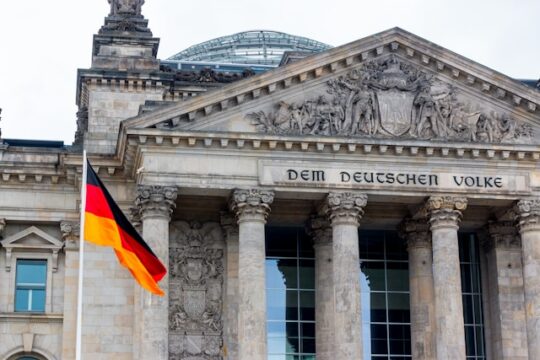


Federal Council Calls for the Return of Voluntary Integration Courses
Last Friday (May 8, 2026), the Federal Council issued an official resolution. In it, the Council calls on the federal government to lift the enrollment freeze on voluntary integration courses.
Specifically, this concerns integration courses under Section 44(4) of the Residence Act. This provision allows individuals who are not legally entitled to an integration course to participate in one on a voluntary basis if there are available spots.
Background: Until now, anyone wishing to voluntarily enroll in an integration course had to obtain approval from the BAMF. However, starting at the end of 2025, these voluntary approvals will no longer be granted.
The Bundesrat—that is, the association of the sixteen federal states—has strongly criticized this measure. In their resolution, the federal states emphasize that language courses are important for integration, social participation, and access to the labor market. A good command of German is crucial for people to find work and become self-sufficient in the long term.
According to the Federal Council, the current restrictions could have exactly the opposite effect: longer dependence on government benefits, poorer prospects for employment and education, and less motivation to integrate.
The Federal Council also emphasizes that integration courses are not only important for people with permanent residency. In particular, people who are seeking permanent residency need to learn German as early as possible.
For this reason, the states are calling on the federal government to once again make integration courses available to voluntary participants.

The integration course is an important part of German integration policy and aims to help migrants integrate into German society and daily life. ...
Background: BAMF to End Voluntary Integration Courses in 2026
As early as late November 2025, the BAMF had already severely restricted admission to voluntary courses. In early February 2026, the agency officially announced in a letter that “until further notice, no admissions” would be granted for integration courses under Section 44(4) of the Residence Act.
The BAMF cited cost-cutting measures and rising course costs in recent years as the reason for this decision. Course enrollments that have already been approved remain valid. However, new voluntary enrollments are no longer being approved at this time.
Who is affected by the restrictions?
Not all migrants are affected by the restrictions to the same extent. The key factor is whether there is a legal right to an integration course or whether participation has so far been voluntary.
Individuals who are legally entitled to do so may continue to participate in courses. This includes, among others, recognized refugees,beneficiaries of subsidiary protection, and individuals with residence permits for employment purposes.
The restrictions apply to individuals without a permanent right to residence. This includes: asylum seekers whose cases are pending, individuals with temporary residence status, refugees from Ukraine with residence permits under Section 24 of the Residence Act, individuals with humanitarian residence permits under Section 25(5) of the Residence Act, EU citizens, and German nationals with special integration needs.
Until now, these groups have been able to voluntarily enroll in integration courses if there were openings available. Currently, this is usually only possible if a government agency explicitly requires them to participate or if the individuals concerned pay for the course themselves.
Language certificates or other proof of language proficiency are required for Naturalization in Germany. Which ones? Find out more...
The federal government is considering further restrictions
In addition to discontinuing voluntary integration courses, the federal government is reportedly considering further changes. This has recently been reported by various media outlets, including the *Westdeutsche Allgemeine Zeitung*.
Accordingly, changes to the course structure and the target language proficiency level are being discussed. For participants who are struggling, the target level could be lowered from B1 to A2.
In addition, discussions will focus on digital self-study periods —that is, times when participants are expected to learn independently online without a teacher—as well as on cuts to class hours in literacy courses.
However, it is important to note that these changes have not yet been officially confirmed or approved.
Conclusion: What happens now?
The Federal Council’s decision is, first and foremost, a political statement. With it, the Federal Council is calling on the federal government to lift the admission freeze. However, it cannot directly compel the federal government to act.
Nevertheless, the decision carries political weight. With this move, the Bundesrat is making it clear that the federal states are critical of the suspension of admissions to voluntary integration courses. After all, it is the states and municipalities in particular that feel the consequences when people learn German later in life, have a harder time finding work, or remain dependent on government benefits for longer. That is why the decision increases political pressure on the federal government.
It remains to be seen whether the federal government will actually rescind the measure or plans further changes. One thing is clear, however: the Bundesrat is an important constitutional body through which the federal states participate in policymaking. Such a decision therefore sends a clear signal to the federal government.