


Why the Settlement permit is so valuable Settlement permit subsidiary protection
Subsidiary protection is a form of international protection in Germany. It is granted to people who are not recognized as refugees under the Geneva Refugee Convention but who face serious harm in their country of origin, such as inhumane treatment or armed conflict.
Those who are granted subsidiary protection receive a temporary residence permit in accordance with Section 25 (2) Alt. 2 of the Residence Act. This is usually initially granted for three years and can then be extended.
Each time the permit is extended, the BAMF checks again whether the conditions for protection still apply. If this is no longer the case, subsidiary protection can be withdrawn. The residence permit therefore does not offer a secure and permanent prospect of remaining in Germany.
That is precisely why the Settlement permit particularly valuable for persons with subsidiary protection. It provides them with a permanent and unlimited Residence permit that is no longer dependent on the situation in their country of origin.
Overall, the Settlement permit offers Settlement permit more security—for example, when starting a job, pursuing education, planning a family, or applying for Naturalization. Family reunification is also easier with permanent residence.
For many people with subsidiary protection, the Settlement permit is Settlement permit the decisive step away from an uncertain, temporary stay to a long-term and reliable prospect of remaining in Germany.

Can I Settlement permit a Settlement permit with subsidiary protection?
Yes —subsidiary protection under Section 25(2) Alt. 2 of the Residence Act Settlement permit preclude the granting of a Settlement permit . This means that even persons with subsidiary protection can Settlement permit a Settlement permit under certain conditions.
Section 26 (4) of the Residence Act (AufenthG) is decisive. This provision clarifies that humanitarian residence permits—including, explicitly, subsidiary protection—are also Settlement permit for the Settlement permit . The specific requirements that must Settlement permit for the Settlement permit are set out in Section 9 (2) of the Residence Act (AufenthG).
Another way to obtain Settlement permit subsidiary protection is via Section 35 (1) of the Residence Act. This provision applies to children, adolescents, and young adults who entered Germany as minors and Residence permit a Residence permit before the age of 18.
The advantage of this route lies in the significantly simplified requirements. In most cases, the Settlement permit Section 35 (1) of the Residence Act does not require a secure livelihood or 60 months of pension contributions. For young people with subsidiary protection in particular, this regulation often represents the easiest and fastest way to obtain a permanent right of residence.
What are the requirements for Settlement permit with subsidiary protection depend on the basis for your claim—i.e., whether you are applying for the Settlement permit Section 26 (4) of the Residence Act or Section 35 (1) of the Residence Act.
We will explain the requirements in the next section.
Requirements: Settlement permit subsidiary protection (Section 26 (4) of the Residence Act)
Section 26(4) of the Residence Act regulates access to Settlement permit persons residing Residence permit Germany with a humanitarian Residence permit . This also includes persons with subsidiary protection under Section 25(2) Alt. 2 of the Residence Act.
The provision is not an independent basis for entitlement, but rather an access rule. It states that holders of humanitarian Residence permit can Settlement permit Residence permit Settlement permit if the general requirements of Section 9 (2) of the Residence Act are met.
The following requirements must be met for a Settlement permit Section 26 (4) of the Residence Act:
Humanitarian Residence permit
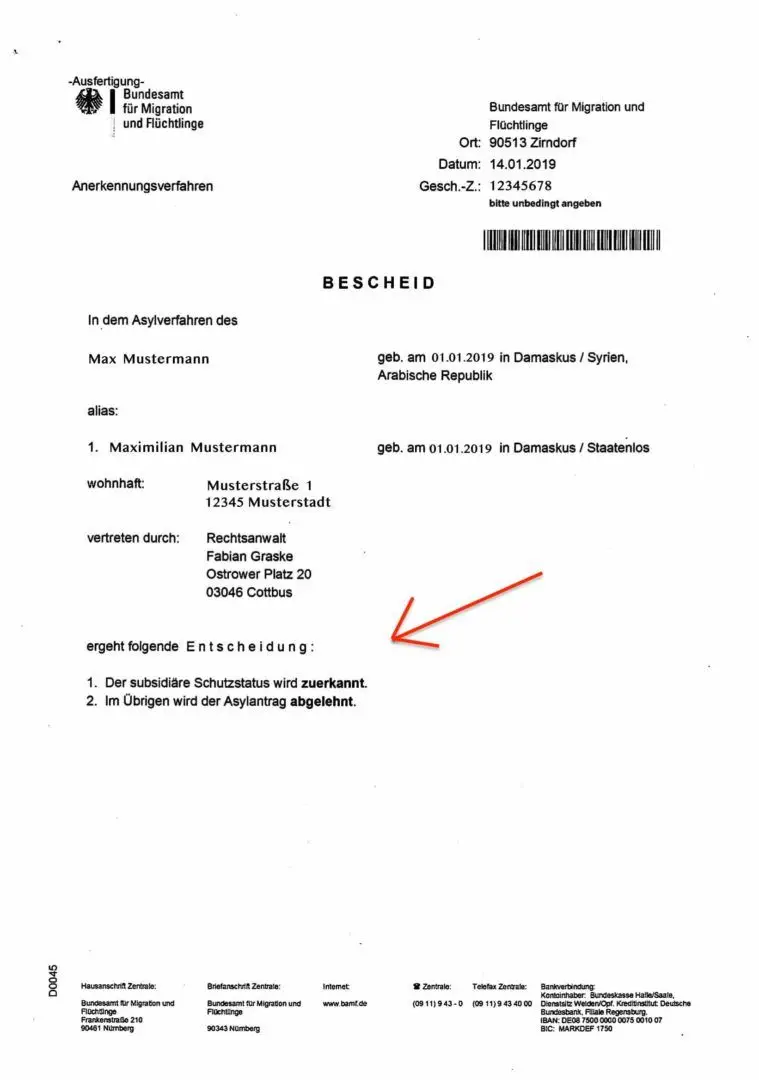
You have a valid residence Residence permit for humanitarian reasons, such as subsidiary protection under Section 25 (2) Alt. 2 of the Residence Act (AufenthG). You can check whether you have this residence permit by looking at your electronic Residence permit your asylum decision.
Five years of possession of a residence permit (
) The residence permit (subsidiary protection) has been valid for at least five years without interruption. The duration of the previous asylum procedure is included in this calculation. This means that the period for the Settlement permit from the moment you submitted your asylum application.
Subsidiary protection has not been revoked or withdrawn. No revocation or withdrawal proceedings are currently underway.
Secure livelihood
Livelihood must be secured independently without benefits under SGB II (citizen's income) or XII (social benefits). Livelihood must be secured for the entire family or community of need. Exceptions only apply in cases of proven physical or mental illness or disability—or other reasons beyond the individual's control.
pension insurance Proof of at least 60 months of contributions to statutory or private pension insurance must be provided. Periods spent raising children or providing care are taken into account.
Sufficient German language skills are required, generally at level B1. Alternatively, a German school or vocational qualification is also sufficient as proof.
Integration
Basic knowledge of the legal and social order must be demonstrated, for example by taking the "Living in Germany" test or by obtaining a German school or training qualification.
Sufficient living space
There must be sufficient living space for the applicant and all members of the family unit living in the same household.
No serious criminal offenses
There must be no significant criminal offenses or threats to public safety.
Important: Unlike recognized refugees (§ 25 (2) Alt. 1 AufenthG), there are no shortened deadlines or simplified requirements for subsidiary protection. A Settlement permit persons entitled to subsidiary protection is therefore generally only possible after five years of legal residence and if all of the above requirements are met.
Requirements: Settlement permit minors with subsidiary protection
Minors with subsidiary protection who are 16 years of age or older may be eligible for a Settlement permit Section 35 (1) sentence 1 of the Residence Act in conjunction with Section 26 (4) of the Residence Act.
Section 35 (1) of the Residence Act (AufenthG) is a special provision for children, adolescents, and young adults who entered Germany as minors and Residence permit a Residence permit before reaching the age of 18.
Minors with subsidiary protection are entitled to a Settlement permit if they meet the following requirements:
Age-
The minor has reached the age of 16 and is still a minor at the time of application (or when all requirements are met).
Five years of legal residence
At the time of reaching the age of 16, a legal residence permit had been in place for at least five years. This also includes periods of asylum proceedings and residence permits for family reasons.
No serious criminal offenses
There must be no serious criminal offenses or other reasons that pose a threat to public safety or order.
German language skills German language skills at B1 level are required. In practice, this is usually demonstrated by regular school attendance or a school leaving certificate in Germany.
Minors with subsidiary protection who apply for a Settlement permit Section 35 (1) sentence 1 of the Residence Act (AufenthG) also benefit from important simplifications: they do not have to be able to support themselves financially. In this case, proof of 60 months of pension contributions is also not required.
This means that minors with subsidiary protection have a particularly good chance of obtaining a Settlement permit thus a permanent right of residence in Germany at an early stage, subject to the conditions set out in Section 35 (1) sentence 1 of the Residence Act.

Requirements: Settlement permit adults with subsidiary protection
Adults with subsidiary protection can obtain a Settlement permit Section 35 (1) sentence 2 of the Residence Act.
Important: This rule does not apply to all beneficiaries of subsidiary protection who are of legal age. It applies exclusively to persons with subsidiary protection who entered the country as minors and Residence permit a Residence permit before reaching the age of 18.
Compared to minor applicants, adults are subject to additional requirements under Section 35 (1) sentence 2 of the Residence Act, particularly with regard to their means of subsistence.
Adults with subsidiary protection are entitled to a Settlement permit if the following conditions are met:
Age-
The person concerned has reached the age of 18 and is therefore of legal age. They entered Germany as a minor and Residence permit a Residence permit before reaching the age of 18.
Five years of legal residence in Germany (
) You have been legally residing in Germany for at least five years. Periods spent in the asylum procedure are included in the calculation of the length of residence.
Secure livelihood
Your livelihood must be secured without benefits under SGB II (citizen's income) or SGB XII (social assistance). Important: If you are in school, vocational training, or higher education, you are not required to secure your own livelihood.
You must demonstrate sufficient knowledge of the German language. As a rule, language level B1 is required for this. Alternatively, language skills can also be demonstrated by a school leaving certificate or completed vocational training in Germany.
This means that if you entered Germany as a minor and Residence permit a Residence permit before reaching the age of 18, you can obtain a Settlement permit under subsidiary protection Settlement permit Section 35 (1) sentence 2 of the Residence Act.
Proof of 60 months of pension contributions is not required in this case. If you are in training or studying at the time of application, you are also exempt from the obligation to cover your own living expenses.
Settlement permit subsidiary protection – comparison of requirements
The requirements you must Settlement permit for a Settlement permit depend on the basis for your claim when you submit your application. If you are applying for a Settlement permit Section 26 (4) of the Residence Act, you must meet different requirements than those for a Settlement permit Section 35 (1) of the Residence Act.
The difference between these two bases for entitlement lies in when you entered Germany (i.e., as a minor or as an adult).
If you entered Germany after reaching the age of 18, you are entitled to a Settlement permit under certain conditions Settlement permit Section 26 (4) of the Residence Act (AufenthG).
If you entered Germany as a minor, you may be eligible for a Settlement permit Section 35 (1) of the Residence Act (AufenthG).
Prerequisite | Settlement permit 26 (4) Residence Act | Settlement permit 35 (1) AufenthG (minors) | Settlement permit 35 (1) Residence Act (adults) |
|---|---|---|---|
Secure livelihood | Yes | No | Individual |
60 months of pension | Yes | No | No |
Residence permit | humanitarian AT, e.g., subsidiary protection | humanitarian AT, e.g., subsidiary protection | humanitarian AT, e.g., subsidiary protection |
length of stay | At least 5 years of legal residence | From the age of 16, at least 5 years of legal residence | At least 5 years of legal residence + entered the country as a minor |
Language | B1 or exception | B1 or exception | B1 or exception |
Naturalization test | Yes or exception | No | No |
National passport | Yes or exception | Yes or exception | Yes or exception |
Criminal offenses | No serious criminal offenses (maximum 90 daily fines or maximum 3 months probation) | No serious criminal offenses (maximum 90 daily fines or maximum 3 months probation) | No serious criminal offenses (maximum 90 daily fines or maximum 3 months probation) |
Sufficient living space | Yes | No | No |
How to apply for a Settlement permit subsidiary protection
The application for Settlement permit be submitted as soon as all legal requirements have been met. Submitting an application too early often leads to queries or even rejection.
Particularly in the case of subsidiary protection, it makes sense to submit the application as soon as all requirements have been met. Many immigration authorities have long processing times. Those who act early can at least better bridge these waiting periods.
The application for Settlement permit subsidiary protection pursuant to Section 25 (2) Alt. 2 of the Residence Act basically follows the same procedure as for other residence permits.
Application:
The application must Foreigners' office in writing or online using the form provided by the relevant Foreigners' office . This is usually the same authority that is responsible for issuing and extending your current residence permit. The method of Settlement permit the Settlement permit —i.e., by mail or online form—may vary from authority to authority.
Make sure you submit the application as complete as possible and include all the necessary documents. It is also important to document exactly when and how you submitted the application—for example, with a confirmation of receipt or proof of shipment.
Review by the Foreigners' office:
After receiving your application, the Foreigners' office will Foreigners' office check whether your humanitarian Residence permit is Residence permit valid and whether you have met the required length of stay. It will then review the other requirements, such as proof of sufficient funds to cover your living expenses and your German language skills. During this step, you may be asked to provide additional information or documents.
Decision:
Once the review has been completed, you will receive written notification. If the decision is positive, you will Settlement permit a Settlement permit . If your application is rejected, the Foreigners' office must provide written Foreigners' office .
The processing time can vary Foreigners' office depending on Foreigners' office and can take several months or even significantly longer. Unfortunately, delays are not uncommon.
Submitting your application early and providing all the necessary documents can facilitate the process. However, this does not guarantee a quick decision. It is therefore important to have realistic expectations regarding the duration of the process and to keep track of all deadlines.
If you have any questions about Settlement permit subsidiary protection, we will be happy to help. Simply take our free test.
What documents are Settlement permit for the Settlement permit ?
The documents Settlement permit the Foreigners' office the Settlement permit depend on the individual case and the basis for entitlement—i.e., whether you are applying for the Settlement permit Section 26 (4) of the Residence Act or Section 35 (1) of the Residence Act.
In practice, the following documents are regularly requested:
Residence permit asylum decision:
You must submit your current Residence permit the positive asylum decision, which shows that subsidiary protection has been granted in accordance with Section 25 (2) Alt. 2 of the Residence Act. These documents prove both your humanitarian residence status and the relevant duration of your stay.
Registration certificate:
A current registration certificate serves as proof of habitual residence in Germany and is regularly requested by the immigration authorities.
Proof of income (if required):
For applicants of legal age, the Foreigners' office will Foreigners' office whether they can support themselves financially. In this case, pay slips, employment contracts, or proof of education or study funding are often requested. Proof of income is not required for applicants who are minors.
Proof of pension insurance (if required):
If proof of pension insurance periods is required, the Foreigners' office will request Foreigners' office pension insurance history, proof of compulsory or voluntary contributions, and, if applicable, certificates of credited periods, e.g., child-rearing or caregiving.
Proof of German language skills:
Proof of German language skills can be provided, for example, by a language certificate from telc or the Goethe-Institut. Alternatively, language skills can also be demonstrated by a German school or training certificate.
Proof of knowledge of the legal and social system:
Proof is usually provided by successfully completing the "Life in Germany" test. Here, too, German school or training qualifications are recognized as equivalent proof.
Proof of identity:
Identity must always be clarified, for example by means of a valid national passport or a recognized passport substitute. In humanitarian situations, however, it is recognized that it is not always possible to obtain all the necessary documents. The decisive factor is whether Clarification of identity is Clarification of identity and has been seriously attempted.
School, training, or study certificates (if required):
Especially for applications under Section 35 (1) of the Residence Act, the Foreigners' office requests school certificates, transcripts, and proof of training or studies that have been started or completed.
Additional documents (if necessary):
Proof of sufficient living space (rental agreement and regular rent payments). Proof of existing health insurance.
The Foreigners' office request additional documents during the ongoing procedure. It is therefore advisable to submit the application as complete as possible and to carefully collect and store all supporting documents.
What to do in case of rejection or delay?
If the application for a Settlement permit , applicants are entitled to receive a written notification stating the reasons for the rejection. Only such a notification makes it clear why the Foreigners' office rejected Foreigners' office application and on what legal basis it did so.
Those affected can lodge an appeal or take legal action against a negative decision. However, the reason for the rejection is always important.
If the Foreigners' office rejects Foreigners' office application because the legal requirements have not been met, the decision is usually lawful. The situation may be different if the authority imposes requirements that are not provided for by law or if essential circumstances of the individual case have not been taken into account.
The statutory deadlines are particularly important in this regard. Appeals or legal action must generally be lodged within one month of the decision being delivered. If this deadline is missed, the application for Settlement permit can be resubmitted Settlement permit .
Long processing times are also not uncommon at immigration authorities. If a decision is not made for several months, it may be advisable to inquire in writing about the status of the procedure or to request a prompt decision.
If the authority still fails to reach a decision, a Lawsuit for failure of act be filed. This is possible if more than three months have passed since the application was submitted without the authority having made a decision, provided there is no good reason for the delay.
A Lawsuit for failure of act is a lawsuit filed with the administrative court, which allows those affected to get the Foreigners' office to decide Foreigners' office their application. The aim is not Settlement permit obtain a Settlement permit immediately, but to oblige the authorities to make a decision.
Summary: Settlement permit subsidiary protection
A Settlement permit also possible in principle with subsidiary protection—however, it is not automatic. The decisive factors are the legal route taken to submit the application and the requirements that must be met in the specific case.
For most persons with subsidiary protection, the path leads via Section 26 (4) of the Residence Act in conjunction with Section 9 (2) of the Residence Act. Here, comparatively strict requirements apply, particularly with regard to secure livelihood, German language skills, and pension contributions. As a rule, there are no simplifications for the Settlement permit Section 26 (4) of the Residence Act) with subsidiary protection.
On the other hand, children, adolescents, and young adults who entered the country as minors have significantly better chances. For them, Section 35 (1) of the Residence Act (AufenthG) provides easier access to Settlement permit often without pension contributions and, in some cases, without proof of a secure livelihood. Especially for young people with subsidiary protection, this route is often the fastest and most legally secure.
Regardless of the path you choose, good preparation is crucial. If you know the right legal basis, realistically assess your own requirements, and submit a complete application, you can avoid unnecessary delays and rejections.
In cases of uncertainty, long processing times, or a negative decision, it may be advisable to seek expert advice at an early stage.