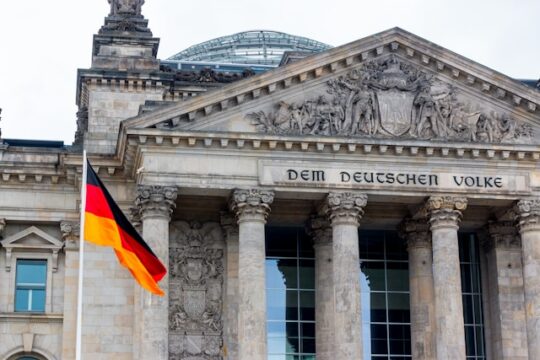
The black-red coalition of CDU/CSU and SPD is thus implementing a key plan from its coalition agreement. However, the planned reform is already attracting significant criticism - including from Employment Minister Bärbel Bas (SPD), the employment agencies and various integration experts.
Background: Return to the legal situation before 2022
The reform ends the special regulation that was introduced shortly after the start of the Russian war of aggression. Since June 2022, Ukrainians with temporary protection status under Section 24 AufenthG have been counted as recognized refugees (not as asylum seekers): They received citizen's allowance, medical care at SGB II level, access to the labor market and consultations at job centers as well as subsidies for integration and language courses.
The German government now wants to return to the legal situation before 2022. This means that in future, Ukrainian refugees who entered the country after the cut-off date (April 1, 2025) or only received their protection status after this date will once again receive the lower asylum seeker benefits.
Ukrainians who came to Germany before the cut-off date retain their entitlement to citizen's allowance permanently.

There are several important things to consider when it comes to Naturalization Ukrainian nationals...
What will change specifically for refugees from Ukraine?
The full draft bill is not yet publicly available. The following key points are known so far:
Lower benefits
Refugees who fall under the new law will not receive citizen's allowance payments in future, but benefits in accordance with the Asylum Seekers Benefits Act. This will reduce the monthly support by around 120 euros.
By way of comparison, while single adults receive a standard requirement of 563 euros under the Citizens' Allowance, benefits under the Asylum Seekers' Benefits Act currently amount to 441 euros per month - of which 196 euros is for personal needs and 245 euros for essential needs.
The costs for accommodation and heating will - as before - also be covered by the social authorities under the new regulation.
No entitlement to language and integration courses
Access to the labor market remains fully intact, and consultations at the employment agencies will also continue to be possible. However, there is one important difference: there is no longer a legal entitlement to certain support measures such as integration or language courses. These offers can still be arranged - but only on a case-by-case basis and without guarantee.
Transitional arrangements for recipients of citizen's allowance
A transitional arrangement applies to all those who entered Germany after the cut-off date but before the reform came into force and are currently receiving citizen's allowance : they may continue to receive the citizen's allowance until the end of their current period of entitlement - but for a maximum of three months after the new regulation comes into force. Citizen's allowance already received does not have to be repaid.

§ Section 24 of the Residence Act (AufenthG) is a key legal provision that makes it possible to grant temporary protection in Germany to people who are collectively fleeing war and persecution. ...
Planned job obligation for refugees able to work
Another important point of the reform is a stricter obligation to work. In future, all refugees who are able to work will be under an even greater obligation to actively seek employment - either independently or with the support of the employment agency.
Sanctions could be imposed for non-cooperation, such as cuts to social benefits. The German government hopes that this will provide more incentives to work and speed up integration into the labor market.
New law meets with criticism
The plans have been met with clear criticism in many places. Labor Minister Bärbel Bas (SPD), who presented the bill together with Interior Minister Alexander Dobrindt (CSU), openly expressed her doubts in the Bundestag. She emphasized that integration must be supported through language courses and targeted support. However, the new law makes access to these offers more difficult. This would make entering the labor market more complicated, not easier.
The Federal Employment Agency and several state employment agencies have also voiced similar criticism. As newly arrived Ukrainians will no longer be assigned to the job centers but to the employment agencies, they will lack a structured range of support services. This could make language courses, further training or qualifications more difficult to access. Experts warn that this could delay their entry into the labor market.

Before applying for Naturalization , the question of income arises for many interested parties. Is there a precise requirement and what exactly do you have to pay attention to when providing information? This blog article gives you an overview of which criteria are important when it comes to income and why the amount of...
How many Ukrainians receive citizens' allowance in Germany?
According to the Central Register of Foreigners (AZ), there are currently around 1.4 million people with Ukrainian citizenship living in Germany (as of September 2025). Of these:
- 953,000 of working age,
- 284,000 children under the age of 15,
- 137,000 people aged 65 and over.
According to a study by the Federal Institute for Population Research, around 51% of Ukrainian asylum seekers in Germany had a job in the early summer of 2025, of which 263,610 were in employment subject to social security contributions and 51,137 in marginal employment.
According to the Federal Employment Agency, around 673,000 Ukrainians were receiving basic security benefits (citizen's allowance) in July 2025, including around 188,000 children. For the vast majority of these people, nothing is likely to change as a result of the planned reform.
Only refugees who arrived after April 1, 2025 or will arrive in the future are affected. According to Bild, around 83,640 people are currently covered by this regulation. However, depending on the development of refugee movements, this number could rise further in the coming months.

In this Blog we tell you everything you need to know about dual citizenship...
When will the new law come into force?
The bill is still at the very beginning of the parliamentary process. Next week, the reform will first be approved by the Federal Cabinet. It will then be submitted to the Bundestag for a first reading and then discussed in the relevant committees and in the Bundesrat. After the second debate in the Bundestag, the final vote will follow.
Observers assume that the reform will find a majority in parliament. The law will come into force as soon as it is published in the Federal Law Gazette. However, this is not likely to happen until the first quarter of 2026 at the earliest.