

Naturalization in exceptional cases, without a language certificate
Anyone who wishes to apply for German citizenship must demonstrate sufficient knowledge of German. In practice, proficiency at the B1 level of the Common European Framework of Reference for Languages (CEFR) is required.
Proof can be provided, for example, by a recognized B1 language certificate. German school, vocational training, or college diplomas are also accepted as proof.
In Rhineland-Palatinate, there used to be another option: Those who could not provide a formal language certificate were allowed, in certain cases, to demonstrate their German language proficiency in other ways.
In exceptional cases, the naturalization authority assessed applicants’ language skills during a personal interview. A dictation or comparable written evidence was also acceptable.
The special provision is based on the federal government’s guidelines for implementing the Nationality Act. According to the Ministry of the Interior of Rhineland-Palatinate, however, it has been used only very rarely.
The application guidelines state that a language certificate is not required if the authorities can clearly determine during a personal interview that the applicant possesses the necessary German language skills.

The B1 certificate plays an extremely important role for foreigners. It is an important key to integration in German society and facilitates many processes in everyday life, whether at work or at home....
Rhineland-Palatinate Wants to Abolish the Exception Now
In the future, however, this special provision will no longer apply in Rhineland-Palatinate. The Ministry of the Interior confirmed to SWR that the existing special provision is currently under critical review. The goal is to end the exception in a legally sound manner.
The ministry justifies this move by stating that the requirements for a " Naturalization " must be binding, transparent, and verifiable. For this reason, officially recognized proof of German language proficiency will be required for all naturalizations in the future. A personal interview with the authorities will no longer be sufficient.
Naturalization: These language proficiency certificates are accepted
Anyone who wishes to become a naturalized citizen in Rhineland-Palatinate or another German state must provide proof of their German language proficiency through a recognized document. These include:
- A certificate from the BAMF confirming that you have successfully passed the German Test for Immigrants (DTZ) at the B1 level. This test is offered as part of the integration course.
- a language certificate from a recognized language school at the B1 level or higher
- Successful attendance at a German school for at least four years. "Successful" means that the student was promoted to the next grade level each year.
- a German high school diploma, for example from a Hauptschule, Realschule, Gesamtschule, or Gymnasium
- successful completion of a German vocational training program
- a degree from a German-language university or university of applied sciences
- For children under 16: Evidence of age-appropriate language development
This means that, for example, anyone who has a German high school diploma or vocational training certificate does not need an additional B1 language certificate.
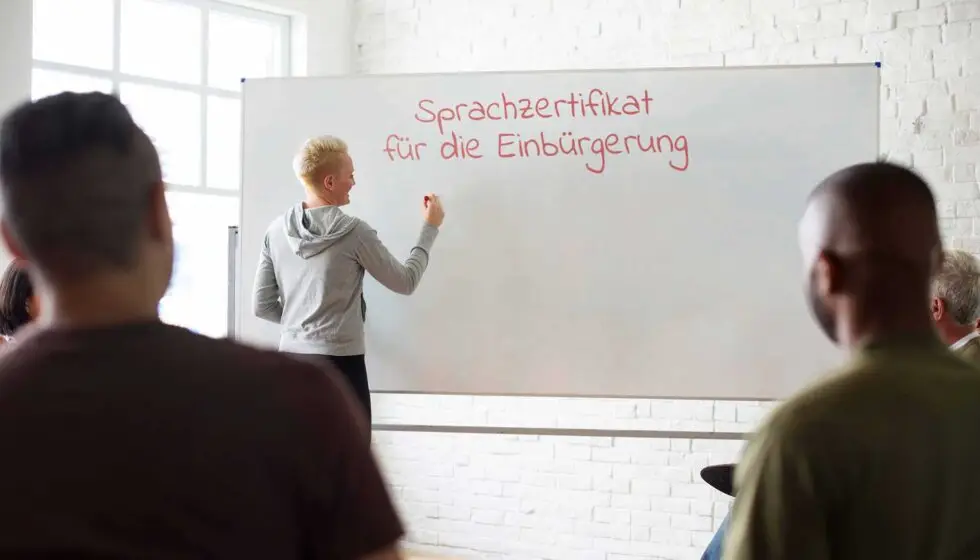
Language certificates or other proof of language proficiency are required for Naturalization in Germany. Which ones? Find out more...
When will the new rule take effect in Rhineland-Palatinate?
The new rule has not yet taken effect. According to various media reports, the Ministry of the Interior of Rhineland-Palatinate is currently examining how the exemption can be phased out in a legally sound manner. A specific date for the transition has not yet been announced.
Until the rule is actually changed, the exception can, in principle, continue to be applied. According to the Ministry of the Interior, however, it has been used only very rarely in the past.
For people who plan to apply for naturalization in Rhineland-Palatinate in the future, it will therefore be even more important to obtain a recognized language certificate early on.
Important: If you do not yet have proof of B1-level language proficiency, you can still submit your application for naturalization and provide the proof later. However, this may delay the process. It is therefore advisable to submit a complete application from the outset, including recognized proof of German language proficiency.