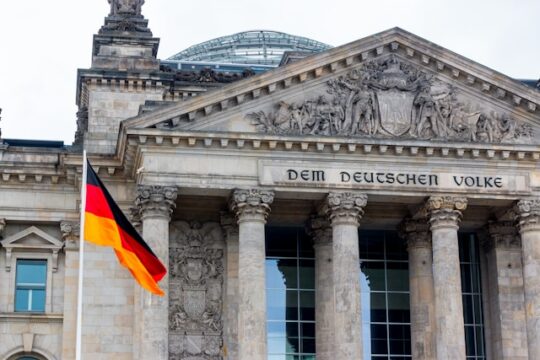


Protection status in Germany automatically extended
Since the beginning of the Russian war of aggression in 2022, Ukrainians in the EU have received protection under the so-called Mass Influx Directive. In Germany, this is implemented through a residence permit in accordance with Section 24 of the Residence Act (AufenthG).
With the current EU decision, this residence permit will now remain in place until 2027. Previously, a regulation stipulated that the Residence permit was automatically extended without the need for an asylum application.
This regulation is currently valid until March 4, 2026, but in order for it to continue until 2027, the federal government will have to issue a new regulation - which is considered highly likely. Without such an automatic solution, hundreds of thousands of refugees would have to extend their Residence permit individually.

§ Section 24 of the Residence Act (AufenthG) is a key legal provision that makes it possible to grant temporary protection in Germany to people who are collectively fleeing war and persecution. ...
No multiple applications possible in Germany and the EU
A key point of the new EU decision is that refugees from Ukraine who have already received a Residence permit in another EU country in accordance with the mass influx directive may not be granted protection status in Germany.
The BMI has been implementing this since August 13, 2025:
- Applications for temporary protection in Germany will be rejected if a corresponding Residence permit already exists in another EU member state.
- Those affected are then obliged to leave the country and are not entitled to citizen's allowance. They will only receive reduced benefits in accordance with the Asylum Seekers Benefits Act.
Change to other Residence permit possible
Ukrainians who receive protection in Germany in accordance with Section 24 AufenthG can in principle also change to another Residence permit - provided they meet the relevant requirements. The BMI instructs the immigration authorities to inform applicants of this.
This is because different Residence permit entail different rights and obligations - e.g. with regard to living expenses, BAföG entitlement, employment promotion, residence requirements or family reunification.

There are several important things to consider when it comes to Naturalization Ukrainian nationals...
Possible alternatives to § 24 AufenthG
Instead of a residence permit according to § 24, refugees from Ukraine can apply for the following titles, for example:
- Training & studies: §§ 16a-16f(school, training, studies, internship, language course)
- Work: §§ 18a, 18b, 18g (skilled workers, EU Blue Card)
- Research & Science: §§ 18d-18f
- Employment in bottleneck occupations: Section 19c (1) in conjunction with. § Section 22a BeschV
- Work without recognition of qualification: § 19c para. 2 in conjunction with § 6 BeschV. § 6 BeschV
- Voluntary service & self-employment: § 19e, §§ 20a, 21
Important: A Residence permit in accordance with Section 24 AufenthG and a new Residence permit may not exist at the same time (Section 19f AufenthG). However, a direct change is possible - provided that the protection status under Section 24 ends before the new permit is issued.
This applies in particular to the following titles:
- § 16b: Studies
- § 16e: Study-related internship in the EU
- § 17 para. 2: Study application
- § 18d: Research
- § Section 18g: EU Blue Card (here additional restrictions in accordance with Section 19f (2) no. 2)
- § 19e: European Voluntary Service
This block does not applyto other titles that are not affected by Section 19f AufenthG - such as Section 18a (skilled workers with vocational training) or Section 18b (skilled workers with an academic education). These can still be applied for in parallel with Section 24 AufenthG.

Since October 2024, Section 47b AufenthG has regulated the obligation to notify the authorities when traveling home with protection status. Find out which requirements apply, what risks exist and how you can avoid having your protection status revoked. All information on exceptions, consequences and practical tips....
Conclusion: What does this mean for refugees in Germany?
- Security until 2027: Most of those affected can assume that their protection status will be automatically extended.
- Caution with double applications: Anyone who already has protection in another EU country cannot receive protection status in Germany and is considered to be obliged to leave the country.
- New opportunities: A move to another Residence permit, e.g. to study, train or work, opens up long-term prospects.
The automatic extension of protection until 2027 is intended to prevent millions of Ukrainians from having to submit regular asylum applications. The EU Council justifies its decision by stating that ending the protection status would overburden the asylum systems in Europe.
In order for the protection to actually apply until 2027, the German government must pass a new ordinance to ensure that it continues to apply. It can be assumed that this will happen soon.
For most refugees from Ukraine, however, this already means that their stay in Germany is secure for the time being: Their stay in Germany remains secure for the time being - with clear rules and new opportunities for the future.