

Residence permit a confirmed identity: What was the case about?
The case involved a woman from Iraq who had come to Germany with her family as a child. The plaintiff had initially held a Residence permit for family reasons. After reaching the age of majority, she sought to extend this residence permit.
However, the relevant Foreigners' office the application. The reason given was that the plaintiff could not sufficiently prove her identity because she did not have a valid national passport.
The woman explained that she had made numerous attempts to obtain the documents. Among other things, she had contacted the Iraqi Embassy, consulted lawyers in Iraq, sought assistance from counseling centers in Germany, and tried to obtain information through her family.

Leipzig, December 18, 2025 – In its ruling of December 18, 2025 (Case No. 1 C 27.24), the Federal Administrative Court (BVerwG) clarified the rules regarding Clarification of identity naturalization proceedings. The ruling makes clear that while a passport is the most important document, Naturalization a passport is...
This is how the court ruled
Initially, the plaintiff prevailed in the Göttingen Administrative Court. However, in the next instance, the Higher Administrative Court (OVG) of Lower Saxony ruled otherwise and dismissed the lawsuit.
In the judges’ view, the plaintiff’s identity had not been sufficiently established. Although she was able to demonstrate that she had made efforts to obtain the documents, the court found that these efforts were not entirely transparent and were, in some respects, contradictory.
In this context, the court also explained the rules that apply when determining identity. Accordingly, the so-called tiered model can also be applied in the context of residence law.
This means that those affected must first attempt to prove their identity using official documents, such as a national passport. Only if this is not possible or reasonable may other forms of proof be considered.
In this specific case, the court did not consider these requirements to have been met. In the judges’ view, the plaintiff had not taken all reasonable steps to obtain the documents. Consequently, an important requirement for the extension of the residence permit was lacking.
What is the step-by-step model for clarifying identity?
The step-by-step model for Clarification of identity originally developed by the Federal Administrative Court. It is primarily used in naturalization proceedings and specifies how a person’s identity can be verified and which documents are accepted for this purpose.
In its ruling, the Higher Administrative Court of Lower Saxony confirms that this model can also be applied in the context of residence law—for example, when determining whether a person’s identity is considered established for the purpose of granting or renewing a residence permit.
Simply put, the tiered model outlines which forms of identification can be accepted during identity verification. It’s important to note that identity does not necessarily have to be verified solely with a passport. Instead, the verification process proceeds in stages—from stronger to weaker forms of identification.
The individual steps are:
Step 1: Official identification documents
The most important and simplest option is a valid national passport. This is the standard requirement and the most reliable form of identification.
Step 2: Alternatives to a national passport
If you do not have a passport and (can prove that) you are unable to obtain one, other official documents may be used. These include, for example, birth certificates, driver’s licenses, school records, or registration documents from your country of origin.
Important: If the national passport (Level 1) is not available, you should gather as many alternative forms of identification (Level 2) as possible.
Step 3: Witness statements and supplementary documents
If such documents (Step 2) are missing, supplementary evidence may be considered. This includes, for example, unofficial documents or witness statements from family members or other individuals whose identities have already been verified.
Step 4: Self-reported identity information (exceptional case)
Only when all other possibilities have been ruled out may, in exceptional cases, self-reported, credible identity information be sufficient. To qualify, the information must be well-founded and verifiable.
It is important to note that the authorities must review these steps in order. Therefore, an application for a Residence permit not be denied solely because the applicant does not have a passport.
At the same time, however, those affected must also play an active role. They must take all reasonable steps to establish their identity and document their efforts in a transparent manner. Only in this way can it be demonstrated that a passport truly cannot be obtained and that, as a result, other forms of proof from the subsequent stages must be taken into account.
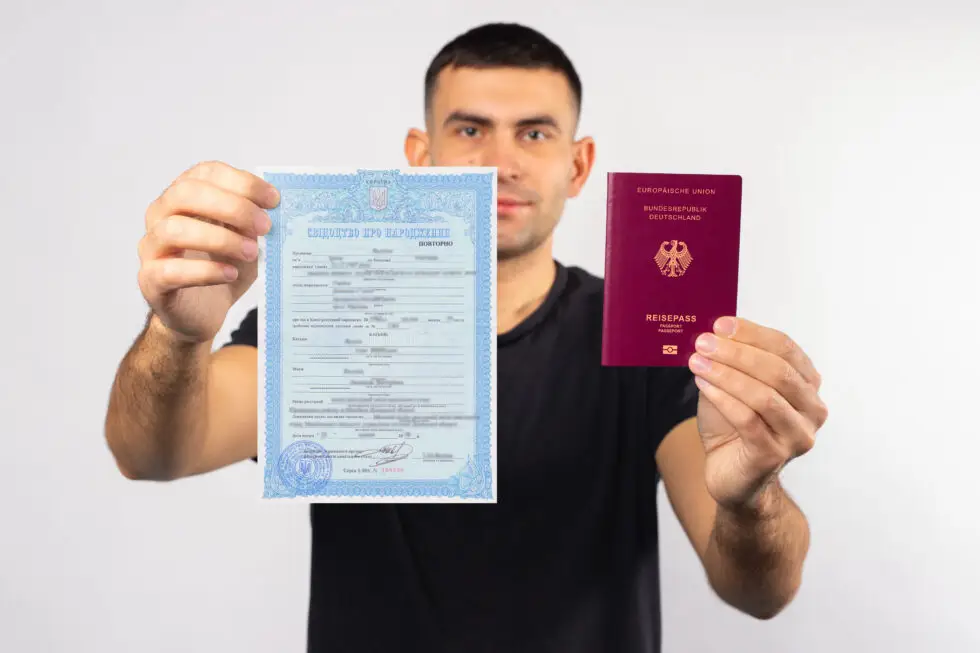
The legal basis for Naturalization Germany is established in the first sentence of Section 10(1) of the Nationality Act (StAG) regarding proof of identity....
Why is this ruling important?
The ruling is important above all because it underscores once again that the tiered model applies not only to naturalization but can also be applied when granting residence permits.
This is an important decision, especially for people who have difficulty obtaining documents from their country of origin. It means that the lack of a national passport Residence permit not Residence permit from receiving a Residence permit .
What does the ruling mean for those affected?
For those affected, the decision shows that even without a passport, a Residence permit is Residence permit automatically ruled out. The tiered system opens up the possibility of proving one’s identity by other means.
However, the ruling also makes it clear that the requirements are high. One’s own efforts must be fully documented, consistent, and easy to verify.
Anyone who cannot present a national passport should therefore be able to provide clear proof that:
- which inquiries were submitted to government agencies or embassies,
- what feedback was received,
- and what additional steps were taken.
This is the only way to convincingly demonstrate that Clarification of identity a passport is not possible or reasonable.