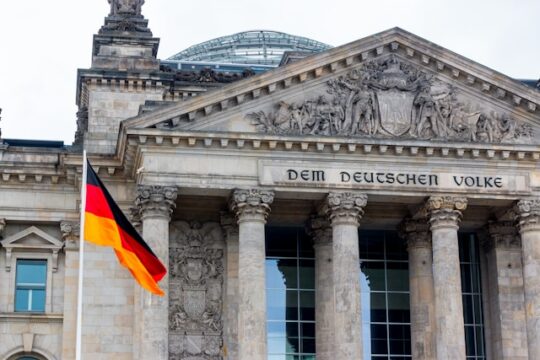


EU Discusses the Future of Protected Status for Ukrainians
Since the start of Russia’s war of aggression in February 2022, Ukrainian refugees have been covered by the European Union’s so-called Mass Influx Directive. This regulation allows people from Ukraine to receive protection in EU member states without having to go through an asylum procedure. They are therefore not considered asylum seekers but are granted protection status directly.
The temporary protection has already been extended several times and is currently in effect until March 4, 2027. EU member states are now discussing what should happen after that. According to media reports, two possible proposals are on the table:
- Either the protected status for all Ukrainians will be extended for another year, until March 2028.
- Or the EU may extend the protection status in principle, but exclude Ukrainian men between the ages of 23 and 60 who are subject to military service from temporary protection.
As things stand , the restriction would likely apply only to men entering the European Union for the first time. Ukrainians who are already living in an EU member state and have been granted temporary protection there would, according to current plans, likely not be affected.
The federal government plans to stop providing certain refugees from Ukraine with basic income or welfare benefits in the future. Instead, they are to receive benefits under the Asylum Seekers Benefits Act. The regulation is actually scheduled to take effect on July 1, 2026. However, the...
Background: What is temporary protection?
Temporary protection was activated shortly after the war began to ease the burden on the asylum systems of individual EU member states. As a result, refugees from Ukraine are not required to file a formal asylum application. Instead, they are granted the right of residence immediately, thereby gaining faster access to essential government services.
In Germany, this protection is provided under Section 24 of the Residence Act. Among other things, those affected receive:
- the right to reside in Germany
- Access to the labor market
- Access to health care and education
- Eligibility for Social Security Benefits
- Options for family reunification
According to EU figures, approximately 4.33 million people had such protected status in March 2026. Most of them live in Germany, Poland, and the Czech Republic. In Germany alone, more than 1.1 million people from Ukraine are currently under temporary protection.
Why is an exemption for Ukrainians being discussed?
The debate stems from the situation in Ukraine. The country is now in its fifth year of fighting against Russia’s war of aggression. At the same time, it faces challenges in recruiting soldiers as well as a growing labor shortage.
Several EU member states therefore believe that Ukrainian men of military age should no longer automatically be granted refugee status in the EU.
Austrian Interior Minister Gerhard Karner (ÖVP) told *Welt* that Ukraine needs its own male citizens not only to defend the country but also to maintain its economic vitality.
Federal Interior Minister Alexander Dobrindt (CSU) also expressed openness to the restriction. At the meeting, he made it clear that while Germany supports an extension of the Mass Influx Directive, he expressed doubts as to whether Ukrainian men of military age should continue to be automatically covered by it.
EU Home Affairs Commissioner Magnus Brunner said he believed it was possible that a majority of member states would support the proposal.
Under Ukrainian law, men between the ages of 23 and 60 are generally not permitted to leave the country. The new EU restriction would therefore also apply to them. Exceptions to the Ukrainian travel ban currently apply to single parents, athletes, journalists, and men between the ages of 18 and 22.

The EU is extending protection for Ukrainian refugees until March 2027, giving over 4.3 million people quick access to work, education and medical care - without an asylum procedure. You can read what this means here....
Ukrainians would have to apply for asylum in the future
If the restriction is adopted, Ukrainians between the ages of 23 and 60 entering the country would no longer be granted temporary protection. Instead, they would likely have to file a regular asylum application. Eligibility for protection would then be assessed on a case-by-case basis.
This would have significant consequences: The men in question would no longer have the same rights as other refugees granted temporary protection. Instead of a right of residence and immediate access to employment and social benefits, the rules of the standard asylum procedure would initially apply.
According to various media reports, the EU is also exploring how the regulation could be implemented as simply as possible. Among other things, there is discussion about whether a Ukrainian exit stamp could serve as proof that a person has left Ukraine legally.
No decision has been made yet
These proposals are not universally welcomed. Some member states are calling for the current protection status to be extended without restrictions.
No final decision on the future of the protected status was reached at the meeting of EU interior ministers. First, the European Commission must submit an official proposal. After that, the member states must discuss and vote on it.
At present, there are strong indications that the European Union intends to extend temporary protection for refugees from Ukraine beyond March 2027. However, it remains unclear whether this protection status will continue to apply to all refugees or whether special rules will be introduced in the future for Ukrainian men between the ages of 23 and 60.