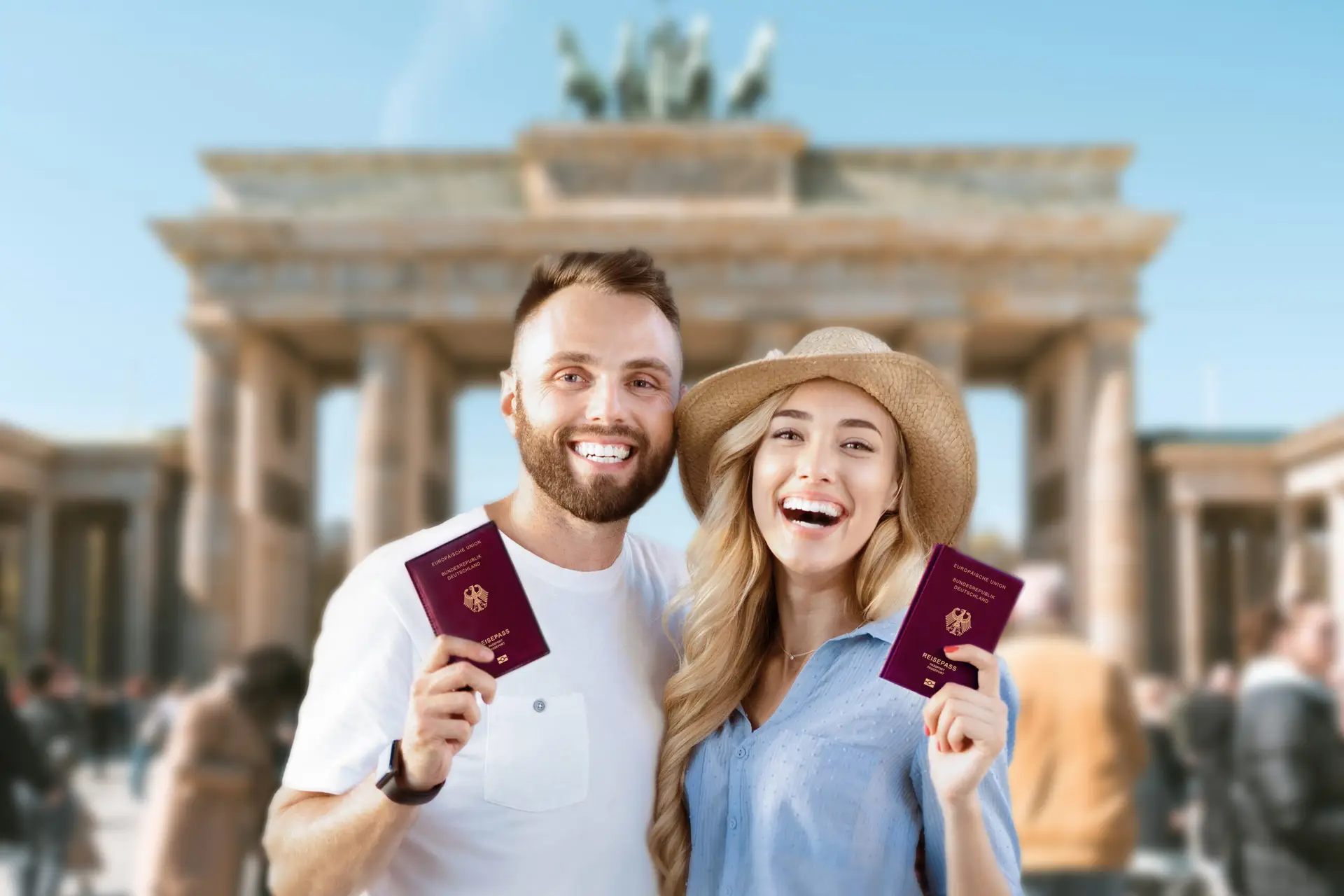

Requirements for Naturalization in Germany in 2024
Naturalization in Germany is linked to certain requirements that you must fulfill. These include not only a minimum length of stay, but also knowledge of the German language and a willingness to integrate into German society. Let's take a look at the necessary conditions for you to start with.
Duration of stay and legal residence
To obtain German citizenship, you must have been legally residing in Germany for at least 5 years, in accordance with Section 10 of the German Nationality Act (StAG). The length of residence requirement was reduced from 8 years to 5 years under the new Naturalization Act, which took effect on June 27, 2024.
The law also provided for a reduction of the residency period to three years. To qualify, however, an applicant had to demonstrate significant efforts toward integration as well as German language proficiency at the B1 level. This form of Naturalization also known asNaturalization.” However, it has no longer been possible since October 2025.
Language skills and naturalization test
Another key requirement for meeting the eligibility criteria is sufficient knowledge of German. Generally, a B1 certificate is required. This level represents basic language skills that enable you to communicate easily in everyday situations.
In addition to language proficiency, you must take the naturalization test (also known as the “Life in Germany” test ). This test covers questions on the topics of law, history, and society in Germany. By taking this test, you demonstrate your knowledge of the legal and social systems and living conditions in Germany. The test is administered by the Federal Office for Migration and Refugees (BAMF).
You can find the test centers where you can register, and you can prepare perfectly with our free app
Further conditions for Naturalization in Germany
In addition to the above-mentioned requirements for a Naturalization in the Federal Republic of Germany, there are further conditions for fulfilling the entitlement to Naturalization :
Your identity and citizenship must be verified (valid passport or alternative identification documents).
You must be able to support yourself and your family without state assistance.
You must provide proof of a signed declaration of loyalty and the signed information sheet on commitment to the free democratic basic order.
- You must not have committed any serious crimes
- Your Residence permit be Naturalization for Naturalization
If you meet these requirements, German citizenship is one step closer for you and your application is ready with the completed application form.

The application for Naturalization
The naturalization process in Germany requires not only that you meet the requirements, but also that the application is submitted correctly and on time. A well-prepared application can help to speed up the process and avoid possible delays.
When and how to submit the application?
It is advisable to submit your application to Naturalization early, preferably three months before you meet all the requirements. This gives the authorities enough time to check your documents and start the process while you are still completing the remaining requirements, such as the language certificate or taking the naturalization test.
- Timing: Preferably three months before all requirements are met
- Authority: You submit the application to the naturalization authority responsible for you
- Procedure: First, it is checked whether all requirements are met, then the application is processed
Documents required for the naturalization application in Germany
In order for your application to be processed in full, you must submit various documents. An incomplete application can lead to delays, so it is important to be well prepared. Here are the most important documents you will typically need:
Valid passport (birth certificate etc.)
Proof of legal residence (Residence permit) in Germany and the extended registration certificate
Language certificate (B1 or higher)
Proof of sufficient means of support (employment contract, pay stubs, tax assessment notices)
biometric passport photo
Rental agreement (proof of rental payment)
Certificates or proof of integration efforts (proof of passing the naturalization test, etc.)
Here we have created a graphic overview of the complete Naturalization process for you:

When is it Naturalization to file a Lawsuit for failure of act Naturalization ?
Take note of the legal processing deadline for the Foreigners' office. Your Foreigners' office 12 weeks to process your application. After 12 weeks, you have the right to file a Lawsuit for failure of act to expedite the processing. You Lawsuit for failure of act the Lawsuit for failure of act with the competent administrative court.
Naturalization for family members
Your family members can also be considered as part of your Naturalization . This means that spouses and minor children can also be naturalized under certain conditions. This option offers a simple solution to include the whole family in the naturalization process.
- Spouse: Can also be naturalized if the marriage has existed for at least two years and the spouse has lived legally in Germany for 4 years and also meets the basic requirements
- Children: Minors may generally be naturalized along with their parent after three years of lawful residence in Germany. They must live with the parent seeking naturalization as part of a family unit. For children under the age of six, it is sufficient if they have spent Naturalization half of their lives in Germany immediately prior to Naturalization .
Similar conditions apply to your family members as to you in terms of language skills, livelihood and exemption from punishment. It is therefore important to prepare these documents as well.

New regulations since June 2024
A new naturalization law has been in effect in Germany since June 27, 2024, making it significantly easier and faster to obtain German citizenship. The changes to the law affect not only the length of residence but also the option to retain one’s previous citizenship and simplified requirements for certain groups of people.
Shortened duration of stay to 5 years
One of the most significant changes in the new law concerns the reduction in the required length of residence. Previously, applicants had to have lived legally in Germany for at least 8 years to Naturalization . Under the new law, the minimum length of residence with a residence permit required for the naturalization process is now only 5 years.
- Previously: 8 years of residence
- Now: 5 years stay
No renunciation of previous citizenship
Another key advantage of the new law is the option to retain one’s previous citizenship. Before 2024, it was often necessary to renounce your original citizenship in order to obtain German citizenship. This has now changed:
- Dual Citizenship: As of June 2024, you may retain your previous citizenship when you acquire German citizenship.
- Advantage: You benefit from the rights and obligations of both countries and do not have to make any difficult decisions regarding your identity and nationality.
- Check with your country of origin: Ask whether your home country recognizes dual citizenship and check and research carefully. Dual citizenship will only work if this is the case.
Simplified Naturalization for guest workers and their descendants
Since 2024, Naturalization an additional simplification of the Naturalization for former guest workers and their spouses (provided the spouses arrived in Germany within 10 years of the guest workers’ arrival). This provision applies to individuals who came to the Federal Republic of Germany under the guest worker programs through 1974 or to the German Democratic Republic as contract workers.
Many of these individuals faced difficulties in obtaining German citizenship due to a lack of language skills—since they rarely had access to language courses or integration courses at the time—or because of bureaucratic hurdles.
- No requirement to take the naturalization test: Former guest workers and contract workers are not required to take the naturalization test.
- Simplified language certificate: It is sufficient to prove basic language skills (A1) in order to be naturalized.

Naturalization in other countries in comparison
The naturalization requirements vary greatly from country to country. While Germany has introduced some simplifications with the 2024 reform, other countries have different regulations regarding the duration of residence, language skills and the possibility of retaining the original citizenship.
Let's take a comparative look at how Naturalization works in countries such as the USA, Canada, Australia and some European countries.
Naturalization in the USA and Canada
Naturalization the United States and Canada is subject to criteria similar to those in Germany. However, there are also differences in the length of residence and the requirements for applicants.
USA: According to the US government , you must first have a green card for Naturalization . The minimum period of residence is 5 years, but spouses of US citizens can apply after just 3 years. They must not have been outside the USA for more than 6 months during this time. In addition, a good reputation and proof of English language skills as well as basic knowledge of the US government and history are required.
Canada: According to the Canadian government's website, the path to citizenship in Canada is a little faster. You must be at least 18 years old and have spent 3 of the last 5 years in Canada. Similar to Germany, you must prove your language skills - in Canada either in English or French. You will also have to pass a citizenship test, which tests your knowledge of the country and your rights and obligations as a Canadian citizen.
Naturalization in other European countries
There are also significant differences in naturalization requirements within Europe. Countries such as France, Switzerland, Great Britain, Austria and Spain offer various options for acquiring citizenship.
Here are a few examples with the most important key points from some European countries:
Switzerland(Swiss government website):
- At least 10 years residence
- Possession of a permanent residence permit (C permit)
- There are simplified naturalization procedures for spouses and third generations
Austria (Austrian Government website):
- At least 10 years of legal residence
- Proof of German language skills (language level B1)
- Proof of a secure livelihood
- No previous convictions and no pending criminal proceedings
United Kingdom (British Government website):
- At least 5 years residence and 1 year with permanent residence permit (ILR)
- No more than 450 days of absence during the last 5 years
- Good knowledge of English and a naturalization test
- Commitment to remain permanently in the United Kingdom
France (Airiau Avocat):
- 5 years residence (or 2 years in the case of a French university degree)
- Good knowledge of French (language level B1)
- Integration into French society and respect for republican values
Spain (Spanish Ministry of Justice website):
- 10 years residence (or 1 year if married to a Spanish citizen as spouse)
- Renunciation of original citizenship
- No criminal record, proof of financial independence
Naturalization in Australia
According to the Australian government, Australia has specific requirements to ensure that you are both integrated and have built a strong bond with the country.
- You must have lived in Australia for at least 4 years, including 12 months as a permanent resident. During this time, you must not have been outside the country for more than 12 months, and no longer than 90 days in the last 12 months.
- A police clearance certificate is required and you must pass the Australian citizenship test, which tests your knowledge of the country, its history and the English language.
- It is also expected that you intend to stay in Australia permanently and actively integrate into society.
Naturalization Residency Requirements for Naturalization
Depending on the country, Naturalization may be possible Naturalization or later. Here is a brief comparison:
Fast Naturalization:
- With a residence period of 3 years (three of the last 5 years), Canada offers a relatively fast Naturalization.
- Spouses of US citizens can also be naturalized after 3 years.
Medium-fast Naturalization:
- In Germany and France, the average length of stay is 5 years.
- In New Zealand, permanent residence permits can be applied for after just one year and Naturalization after 5 years of residence.
Longer Naturalization:
- In countries such as Austria, Spain and Switzerland, applicants often have to live in the country for 10 years before they can obtain citizenship.
In the Migration Integration Policy Index (Mipex), you can see exactly where, Naturalization can be completed the fastest, statistically speaking.
We have also created a video on the speed of Naturalization :
Conclusion on Naturalization in Germany
As you can see, the topic Naturalization is very complex. In this section, we’ve summarized the most important points and Naturalization a look at the future of Naturalization .
The most important key points about Naturalization in Germany
- Minimum stay: 5 years
- Language requirements: Proof of German language skills at B1 level
- Dual citizenship: Permitted since 2024; no requirement to renounce one's original citizenship
- Naturalization Test: Basic Knowledge of the German Legal and Social System Required
- Naturalization Possible SoonerNaturalization 2024: With the introduction of the new naturalization law, Germany is now among the countries with the fastest Naturalization processes Naturalization .
Do you have any questions?
The future of Naturalization in Germany
The 2024 reform is just the beginning. In the future, the process is expected to be further digitalized and accelerated in order to make it easier for more people to obtain German citizenship. Increased integration and the reduction of bureaucratic hurdles in particular are likely to play a key role.
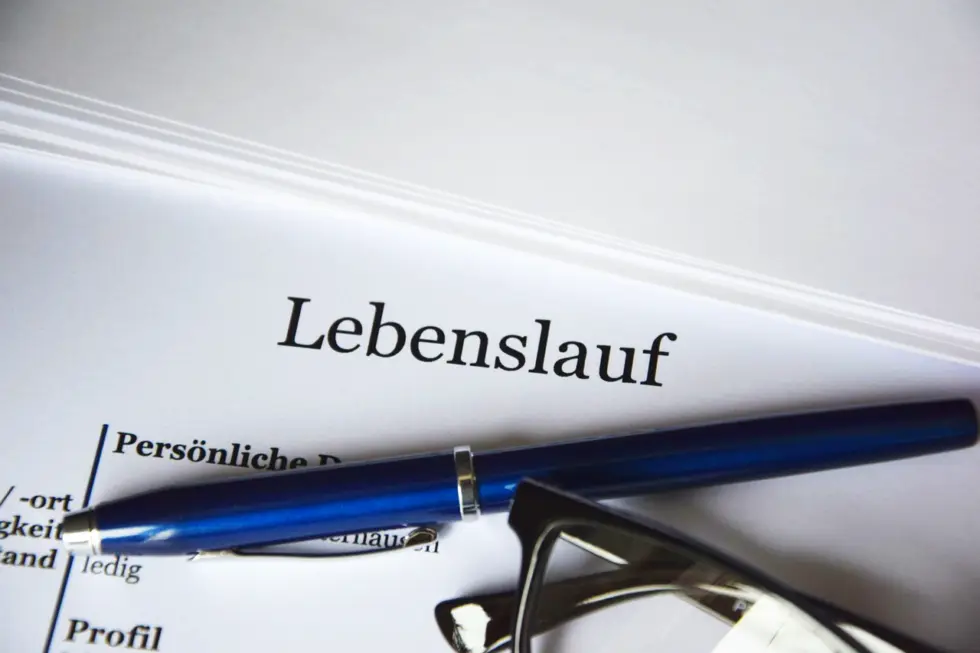
Learn how to create an effective CV for your Naturalization in this comprehensive guide. Discover important tips on how to best present your integration!
FAQ - The most frequently asked questions about Naturalization in Germany
To apply for German citizenship in 2024, you will need, among other things:
- legal residence in Germany for at least 5 years
- Proof of German language skills (B1 level)
- Securing a livelihood without social benefits
- successful completion of the naturalization test
Persons who have been living legally in Germany for at least 5 years and meet the naturalization requirements (including language skills, secure livelihood, naturalization test) may apply for citizenship.
The most important changes under the new naturalization law include:
- Shortening the length of stay from 8 to 5 years
- Recognition of dual citizenship
- Simplified Naturalization certain groups of people, such as former guest workers
In Germany, the standard period of residence required for Naturalization is Naturalization years. In comparison, the Naturalization takes longer Naturalization many other countries:
- Canada: After 3 years of residence
- USA: Generally 5 years, 3 years if married to a US citizen
- Australia: After 4 years of residence
- Switzerland: After 10 years of residence
- Austria: After 10 Years of Residence
- Spain: After 10 years, 1 year if married to a Spaniard
Yes, if they belong to the close nuclear family. Spouses can be naturalized if the marriage has existed for two years and the spouse has lived in Germany for 4 years with Residence permit .
Minor children can be naturalized if they have spent 3 years in Germany with Residence permit or have lived in Germany for half of their lives.